

When a loved one needs intensive medical care, families face one of the hardest decisions of their lives — should the patient stay in a hospital ICU, or can critical care be safely managed at home?
Over the last few years, home ICU care has emerged as a medically sound and increasingly accessible option across India. It is not a shortcut or a compromise — when set up correctly by trained professionals, it is a clinically validated model of care that many patients and families prefer.
This guide walks you through everything you need to know: how home ICU works, who it suits, what it costs, and how it compares to a hospital ICU — so you can make a confident, informed decision.
1. What Is ICU at Home?
ICU at Home is a structured medical service in which a trained clinical team — ICU nurses, attending physicians, and medical technicians — sets up professional critical care equipment at the patient’s residence and provides ongoing monitoring and treatment.
The goal is to deliver the same clinical outcomes as a hospital ICU, while allowing the patient to recover in a familiar, comfortable environment surrounded by family.
Equipment Typically Used in a Home ICU
A properly established home ICU setup includes:
- Ventilator, BiPAP, or CPAP machine (based on respiratory need)
- Multi-parameter monitor tracking ECG, SpO2, blood pressure, and temperature
- IV infusion pump and syringe driver
- Suction machine and airway management kit
- Enteral feeding pump for tube nutrition
- Oxygen concentrator or medical-grade oxygen cylinder
- Pressure-relief mattress to prevent bedsores
- Urinary catheter and closed drainage system
- Dedicated nursing care in 12-hour or 24-hour shifts
- Physician teleconsultation support
All equipment is supplied, installed, and maintained by the service provider. Families are not required to source anything independently.
2. Who Is Home ICU Suitable For?
Not every patient requiring intensive monitoring is a candidate for home ICU. Patient selection is the most important factor in making home critical care safe and effective.
Patients Who Are Well-Suited for Home ICU
- Stroke or brain injury patients who are neurologically stable and past the acute phase
- Patients with advanced COPD, pulmonary fibrosis, or chronic respiratory failure on long-term oxygen support or BiPAP
- Post-surgical patients requiring extended monitoring after major procedures
- Elderly patients managing multiple chronic conditions such as diabetes, cardiac failure, or chronic kidney disease — particularly those who benefit from elder care at home
- Patients in a vegetative or minimally conscious state requiring long-term supportive care
- Spinal cord injury or ALS patients on home mechanical ventilation
- Cancer patients in the palliative phase preferring comfort-focused care at home
- Post-COVID patients with lingering respiratory or neurological complications
When Hospital ICU Is the Right Choice
- Any acute emergency — new stroke, heart attack, septic shock, respiratory arrest
- Patients who require emergency or planned surgery
- Situations requiring frequent advanced diagnostics: CT, MRI, endoscopy, or intensive lab monitoring
- Patients with seizure disorders that are not yet stabilized
Clinical Note: The transition from hospital to home ICU should always be authorized by the treating ICU physician. A formal discharge assessment, including home environment evaluation, is essential before any transfer.
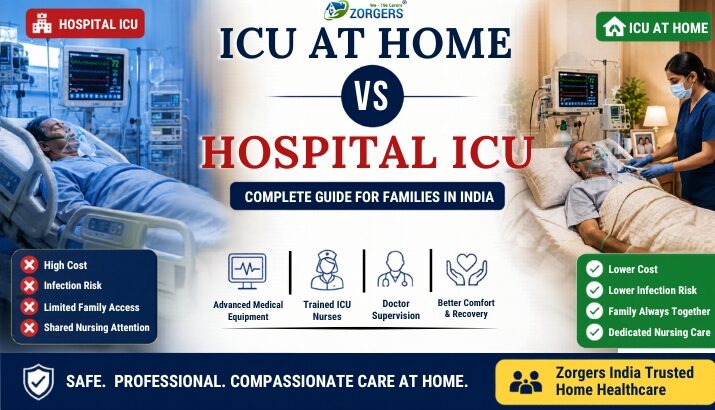
3. Home ICU vs Hospital ICU: Honest Comparison
Where Home ICU Has an Advantage
Recovery environment Research consistently shows that patients recover better in familiar surroundings. Hospital ICU patients frequently experience what clinicians call “ICU delirium” — a state of disorientation, agitation, and disturbed sleep caused by continuous noise, artificial lighting, and the absence of familiar faces. At home, this risk is substantially lower.
Family involvement Hospital ICUs typically restrict visits to 30–60 minutes per day. At home, family members are present continuously — able to assist with meals, personal care, and emotional support. This is particularly significant for elderly patients and those with dementia, for whom family presence directly affects behavior and cooperation.
Infection risk Hospital-acquired infections (HAIs) — including MRSA, Clostridioides difficile, and ventilator-associated pneumonia — are a documented risk in ICU settings. A patient’s home environment carries a microbial load their immune system is already familiar with, which reduces — though does not eliminate — this risk for stable long-term patients.
Nursing attention In most hospital ICUs, one nurse is responsible for two to four patients. A home ICU nurse is dedicated exclusively to one patient throughout the shift, enabling more consistent observation and faster response to changes in condition.
Sleep and rest quality Continuous alarms, procedural activity, and shift changes make hospital ICUs inherently disruptive. Adequate, uninterrupted sleep is critical to immune function and neurological recovery — both of which improve significantly at home.
Rehabilitation continuity Physiotherapy at home can be integrated directly into the home ICU routine — including daily chest physiotherapy for ventilated patients and neuro-rehabilitation for stroke or paralysis patients. This is often more consistent than hospital-based therapy, where sessions may be delayed or cancelled.
Where Hospital ICU Has an Advantage
Emergency response: A hospital ICU has a resuscitation team, crash cart, and surgical team available immediately — something no home setup can replicate.
Diagnostics: CT scans, MRI, endoscopy, blood transfusions, and complex laboratory investigations require hospital infrastructure.
Specialist access: Cardiology, nephrology, neurology consultations happen within minutes in a hospital — at home, these require planned visits or teleconsultation.
Acute instability: Any patient whose condition is changing rapidly belongs in a hospital ICU until they are stabilized.
4. Side-by-Side Comparison Table
Feature Home ICU Hospital ICU Patient environment Home — familiar, calm Hospital ward — clinical Family access Unrestricted Limited visiting hours Daily cost (India)₹8,000 — ₹25,000₹20,000 — ₹80,000Nurse-to-patient ratio1:11:2 to 1:4 Hospital-acquired infection risk Lower for stable patients Higher Emergency response15–30 min via ambulance Immediate on-site Advanced diagnostics Limited portable tests Full infrastructure Sleep quality Significantly better Disrupted Rehabilitation Daily home physio possible Scheduled sessions Elder & dementia care Specialist home support General protocols Best suited for Stable, chronic, long-term Acute, unstable, emergency
5. Cost of Home ICU in India (2024–2025)
Cost is a significant factor for most families. The following figures are based on current market rates across Indian cities and reflect typical package pricing — individual quotes will vary based on provider, equipment required, and level of care.
Service Component Home ICU Hospital ICU Basic daily package₹8,000 — ₹12,000₹20,000 — ₹35,000With ventilator support₹15,000 — ₹25,000₹40,000 — ₹80,000Nursing (12-hr shift)Included₹2,000 — ₹5,000 additional Physician visits1–2 daily Included in ward rounds Oxygen concentrator Included or rentable Included Physiotherapy Available as add-on Billed separately Estimated monthly spend₹2.5L — ₹7.5L₹6L — ₹24L
Approximate Daily Rates by City
- Delhi NCR: ₹10,000 — ₹28,000
- Mumbai: ₹12,000 — ₹30,000
- Bangalore: ₹10,000 — ₹25,000
- Hyderabad: ₹9,000 — ₹22,000
- Pune: ₹9,000 — ₹20,000
- Chennai: ₹8,000 — ₹20,000
- Kolkata: ₹7,000 — ₹18,000
- Chandigarh: ₹8,000 — ₹20,000
- Jalandhar, Ludhiana, Amritsar: ₹7,000 — ₹18,000
Insurance Coverage for Home ICU
Under IRDAI’s 2020 Standardization Guidelines, insurers are required to cover domiciliary hospitalization when a patient cannot be moved to hospital or when hospital beds are unavailable. Several insurers — including Star Health, HDFC ERGO, Niva Bupa, and Bajaj Allianz — include home ICU coverage in select plans.
Before starting home ICU, families should confirm with their insurer whether domiciliary hospitalization is covered, what documentation is required, and whether nursing and ventilator charges are reimbursable separately.
6. Home ICU in Punjab and North India
Punjab has one of India’s highest rates of lifestyle-related illness — including hypertension, diabetes, and cardiovascular disease — alongside a rapidly growing elderly population. This makes home healthcare and home critical care especially relevant across the state.
Families in Jalandhar, Ludhiana, Amritsar, Patiala, Bathinda, and Chandigarh now have access to structured home ICU services. When evaluating a provider in Punjab or North India, the following criteria matter most:
- Nursing staff with verified ICU training (CCRN, BLS, ACLS certification)
- 24/7 physician availability via teleconsultation
- Pre-arranged emergency ambulance (MICU-equipped) within 15–20 minutes
- Clear written service agreement covering response times and escalation protocol
- Experience with elder care at home for older patients with multiple conditions
- Transparent pricing with no hidden charges
If a patient is currently admitted in a hospital in Ludhiana, Jalandhar, or Chandigarh and the treating doctor has recommended a step-down to home care, a home assessment should be arranged 3–5 days before the planned discharge date to allow time for equipment setup and nursing orientation.
7. Frequently Asked Questions
Q1: Is home ICU clinically safe?
For patients who have been assessed as medically stable and suitable for home care, yes. The clinical outcomes for stable chronic patients — including infection rates, pressure injury incidence, and caregiver satisfaction — are comparable to or better than hospital ICU outcomes in published studies. The critical requirement is appropriate patient selection and a qualified clinical team. It is not suitable for patients in acute or unstable condition.
Q2: What equipment does a home ICU require?
The core setup includes a multi-parameter patient monitor, oxygen concentrator or cylinder supply, suction machine, IV infusion pump, pressure-relief mattress, and BiPAP or ventilator depending on the patient’s respiratory needs. All equipment is provided and maintained by the service provider.
Q3: How do I identify a reliable home ICU provider?
Key indicators of a credible provider include NABH accreditation or affiliation with a recognized hospital, nursing staff with documented ICU training, a clear emergency escalation protocol, and a written service agreement. Ask for references from families who have used the service. Read independent reviews on Google and Practo before committing.
Q4: Can a patient on a ventilator be managed at home?
Yes, under the right conditions. Home mechanical ventilation is an established clinical practice for patients with stable ventilator dependence — including those with ALS, high cervical spinal cord injury, post-tracheostomy recovery, and severe COPD. It requires ICU-trained nursing staff, a reliable power backup system, a portable ventilator with alarm capability, and an emergency transfer protocol agreed upon in advance with a nearby hospital.
Q5: How many nurses are needed for home ICU?
Round-the-clock home nursing care typically requires two nurses working in 12-hour shifts. For patients on mechanical ventilation or with multiple infusions running simultaneously, some providers recommend two nurses per shift for added safety. Nursing is generally included within the daily package rate.
Q6: What happens in a medical emergency at home?
This is the most important question families should ask any provider before signing up. A well-structured home ICU service must have a physician reachable by phone or video at all times, an MICU-equipped ambulance available within 15–30 minutes, and a pre-identified receiving hospital for emergency transfer. Family members should also be trained in basic CPR and airway positioning before care begins at home.
Q7: Is home ICU available outside metro cities — for example in Jalandhar or Ludhiana?
Yes. Organized home ICU services are now available in Jalandhar, Ludhiana, Amritsar, Patiala, and Chandigarh, in addition to major metros. Coverage in smaller towns and rural Punjab remains limited, though expanding.
Q8: Is physiotherapy included in home ICU?
Many home ICU packages include or can add physiotherapy services as part of the patient’s care plan. For ventilated patients, daily chest physiotherapy is clinically important to prevent respiratory complications. For stroke, paralysis, and post-surgical patients, regular neuro or orthopedic physiotherapy supports functional recovery and prevents muscle atrophy.
Q9: How long can a patient remain in home ICU?
There is no standard maximum duration. Some patients transition through home ICU over a few weeks before stepping down to general home nursing care. Others with permanent ventilator dependence or long-term disorders remain in home ICU for months or years. The care plan should be reviewed formally by the attending physician every one to two weeks.
Q10: How does the hospital-to-home transition work?
The process typically takes three to five days of advance planning. It begins with written medical clearance from the hospital ICU team, followed by a home environment assessment by the home care provider. Equipment is installed one to two days before the patient’s discharge. The nursing team is briefed on the patient’s condition, medications, and emergency contacts. On discharge day, a detailed medical summary and emergency protocol document should accompany the patient. The first 48–72 hours at home are the most critical adjustment period and require the closest monitoring.
8. Conclusion
Home ICU is not the right choice for every patient — but for those who are medically stable, it offers a genuinely better quality of life, lower infection risk, closer family involvement, and significantly lower costs compared to prolonged hospital ICU stays.
The decision should always be made in consultation with the treating physician, based on a thorough assessment of the patient’s condition and home environment — not on cost alone.
For families in Punjab and across India considering this option, the most important first step is speaking with a qualified home healthcare provider who can assess whether your loved one is a suitable candidate and what a safe, appropriate setup would look like for your situation.