
Who Qualifies? A medically stable patient needing continuous monitoring, ventilator support, oxygen therapy, or specialized nursing — but no emergency surgery or invasive procedures.
Three additional requirements: full-time caregiver, safe home environment, hospital within 30 minutes.
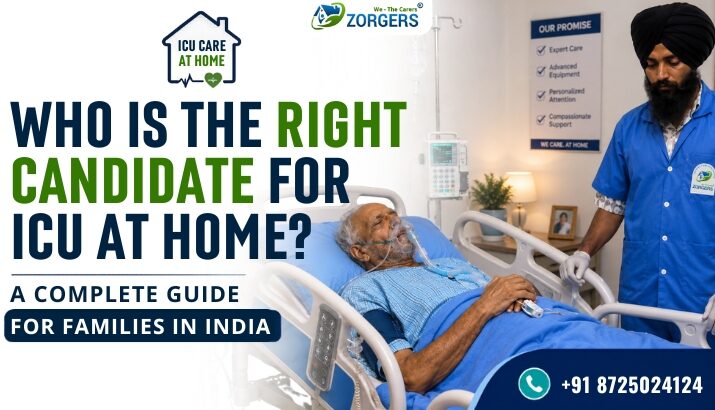
What Is ICU at Home? A medically supervised model delivering hospital-grade care at home — including vitals monitoring, IV medications, oxygen therapy, BiPAP/CPAP, 24/7 nursing, and telehealth consultations.
ICU at Home vs Hospital ICU
| Feature | ICU at Home | Hospital ICU |
|---|---|---|
| Patient Comfort | High | Moderate |
| Family Access | Unrestricted | Restricted |
| Infection Risk | Lower | Higher |
| Cost | 30–50% lower | High |
| Emergency Response | 30 min via escalation | Immediate on-site |
5 Eligibility Criteria
1. Medical Stability — No shock, no invasive ventilation, no surgery needed
2. Qualifying Condition
- COPD care at home — oxygen therapy, nebulization, respiratory monitoring
- Pneumonia care at home — IV antibiotics, oxygen therapy, vitals monitoring
- Stroke rehabilitation at home — neuro monitoring, physiotherapy, functional recovery
- Palliative care at home — pain management, comfort care, family support
- Parkinson care at home — neuro monitoring, movement support
- Congestive heart failure, post-sepsis recovery, post-surgical recovery, diabetic ketoacidosis (mild-moderate), CKD complications
3. Cognitive Cooperation — Alert, communicative, no severe dementia/delirium
4. Dedicated Caregiver — Full-time adult; professional patient attendant or qualified nurse at home also an option
5. Safe Home Environment — Clean room, stable electricity, internet, clean water, hospital within 30 min. A complete ICU setup at home includes multiparameter monitor, oxygen concentrator, BiPAP/CPAP, suction machine, IV pump, hospital bed, and nebulizer.
Patient Selection Process (MDT) Clinical assessment → Nursing evaluation → Social/home assessment → Pharmacy review → Patient consent
Admission only from hospital wards or emergency departments — never directly from OPD.
5 Key Benefits
- Faster recovery in familiar surroundings
- No hospital-acquired infections
- 30–50% cost savings
- Unrestricted family involvement
- Fewer ICU complications — delirium, pressure ulcers, PICS
Service Areas
Chandigarh · Mohali · Panchkula · Jalandhar · Ludhiana · Delhi · Gurugram
Zorgers — ISO 9001:2015 certified | 📞 8725024124 | enquiry@zorgers.com
FAQs
Q1. Who qualifies?
Stable patients needing monitoring/oxygen/IV care without emergency surgery. Caregiver + safe home required.
Q2. Can it replace hospital ICU?
Yes, for stable patients — comparable outcomes with lower infection risk and cost.
Q3. Main risks?
Delayed emergency response, caregiver gaps, equipment issues — managed via 24/7 support and escalation protocols.
Q4. Remote monitoring?
Multiparameter monitors transmit live vitals; daily video consultations + doctor visits at home + nursing reports.
Q5. Insurance coverage?
Varies by insurer. Some private policies and Ayushman Bharat may cover it — verify with your TPA.
Q6. Equipment included?
Monitor, oximeter, oxygen concentrator, BiPAP/CPAP, suction machine, IV pump, hospital bed, nebulizer.
Q7. Nurse visits?
Minimum twice daily; 12-hr or 24-hr duty available. See: nurse at home
Q8. If condition worsens?
Nurse assesses, contacts physician, arranges hospital transfer — 30-minute target response.
Q9. Available in Chandigarh/Jalandhar/Ludhiana?
Yes. Call 8725024124 for availability and free eligibility assessment.
Q10. Need a doctor’s referral?
Recommended. Zorgers coordinates directly with your existing hospital team.