


Quick answer: A care home means your parent moves into a senior residence where care, meals, safety and company are part of everyday life. Home care means trained caregivers, nurses or therapists come to your parent’s own home. A care home usually suits seniors who need regular support and company, or whose home is no longer safe. Home care usually suits seniors who are comfortable at home and need help with specific tasks, recovery or medical care. Many Indian families start with one and move to the other as needs change.
Most families reach this question after a trigger: a fall, a hospital discharge, a missed medicine, or the slow realization that a parent living alone is not eating or talking to anyone. You are not looking for a textbook definition. You want to know what is safer, what is kinder, and what your family can sustain.
This guide compares both options honestly, including where each one falls short, so you can decide with a clear head.
Care Home vs Home Care: The Basic Difference
The simplest way to see the difference is to ask: where does the care happen, and how much of the day does it cover?
- A care home changes where your parent lives. Support is built into the building and the daily routine, and help is always within reach.
- Home care keeps your parent where they are. Support arrives in the form of caregivers or nurses, for the hours you arrange.
Neither is automatically better. The better option is the one that matches your parent’s health, safety needs, personality and family situation right now.
What Is a Care Home?
A care home is a residential setting for seniors who want to stay as independent as they can but need support with everyday life. Your parent has their own room, usually with attached facilities, and the residence provides:
- Help with bathing, dressing, toileting and mobility
- Meals and nutrition planning
- Medication reminders and routine health monitoring
- Housekeeping and laundry
- Staff available through the day and night
- Group activities, exercise and festivals
It is different from a hospital or a nursing home. A care home is designed for people who are largely mobile and need daily support, not continuous medical treatment. It is also different from a traditional old age home, because the focus is on personal care, safety and quality of daily life rather than only on accommodation.
What Is Home Care?
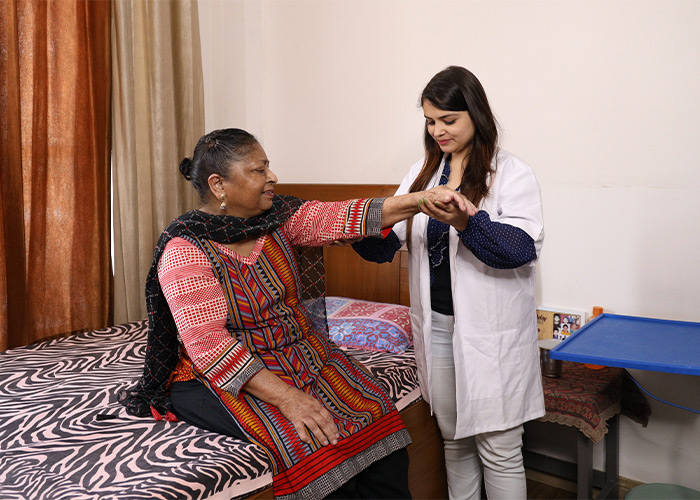
Home care means your parent continues to live in their own house, and care comes to them. Depending on the need, this can include:
- A trained attendant or companion for daily routines such as bathing, meals, walking and medicine reminders
- A nurse for injections, wound care, catheter care, oxygen support or monitoring vitals
- A physiotherapist for recovery after surgery, fracture or stroke
- Doctor visits and medical equipment at home, such as a hospital bed or oxygen concentrator
Care can be for a few hours, a 12-hour shift or round the clock with live-in support. The plan is built around one person and can be increased, reduced or changed as health changes.
Care Home vs Home Care: Comparison
| Factor | Care home | Home care |
|---|---|---|
| Where your parent lives | A senior residence | Their own home |
| Availability of help | Staff on site day and night | Only during booked hours, unless care is 24-hour |
| Personalization | Individual care plan within a shared community | One-to-one, fully built around one person |
| Social life | Built in through shared meals, activities and peers | Depends on family, neighbours and the caregiver |
| Home safety | Environment is designed for seniors | Home may need grab bars, lighting, non-slip floors or a hospital bed |
| Medical support | Basic health monitoring; complex care may need outside support | Nurses, therapists and equipment can be set up at home |
| Family workload | Residence manages daily operations; family visits and stays involved | Family often coordinates caregivers, backups and supplies |
| Flexibility | A move is a bigger life change, though trial stays are possible | Easy to increase, reduce or stop |
Level of Care in Home Care
Think of care in three broad levels. Where your parent sits today, and where they are likely to be in the next year, matters more than the label on the service.
1. Daily living support
Help with bathing, toileting, meals, walking, medicine reminders and company. Both a care home and home care handle this well.
2. Nursing and recovery support
Injections, vitals monitoring, wound care, oxygen support, feeding assistance or physiotherapy after surgery or a hospital stay. Home care can deliver this with qualified nurses and therapists. Many care homes offer basic health monitoring, but the level of nursing differs between facilities, so ask specifically.
3. Advanced or critical care
Needs such as ventilator support, tracheostomy care, suctioning or BiPAP and CPAP management. This is usually delivered at home with trained nurses and equipment under medical guidance, because a care home is not designed for intensive medical care.
If your parent’s needs are likely to rise, ask whether the provider can scale up, and what happens if care needs outgrow what they can offer.
If you have any queries about home care services, you can contact Zorgers Home Healthcare. Zorgers is a trusted option for professional home healthcare services, providing quality care and support to patients and families in the comfort of their homes.
Safety and 24/7 Support Available in Care Home
In a care home, trained staff are on site all day and night. Rooms and corridors are typically planned with seniors in mind, with features such as handrails, non-slip flooring and emergency call systems. If your parent falls at 3 a.m. or becomes unwell, someone is nearby.
At home, safety depends on the house and on the hours of care. Common risks include slippery bathrooms, stairs, poor lighting, and being alone at night. You can reduce these with modifications and, if needed, night-shift or live-in care, but that raises both cost and planning effort.
Whichever route you choose, ask these questions:
- Who responds in an emergency, and how quickly?
- Which hospital is nearest, and is there an ambulance arrangement?
- What happens if the caregiver or staff member is absent?
- How are medicines tracked and double-checked?
- Is there a record or update system so the family stays informed?
Dementia and Alzheimer’s Care in a Care Home
With memory loss, the stage of the condition matters more than the setting.
Early stage. A familiar home can be calming, and many people do well there with a trained caregiver, a steady routine and a safe environment.
Middle and later stages. Safety becomes the main concern: wandering, night-time restlessness, leaving the stove on, not recognising danger, or resisting care. These situations need constant supervision and staff trained in dementia care. That can be arranged at home with 24-hour care, or in a residence with memory care and secure spaces. Dementia care usually costs more in both settings.
Points to check for either option:
- Is the caregiver or staff trained specifically in dementia care?
- Is there a predictable daily routine, with calm and consistent faces?
- How are wandering and night-time risks handled?
- How are agitation and refusal of care managed without force or sedation by default?
- Is the neurologist or treating doctor involved in the care plan?
A sudden move can unsettle someone with dementia, so if a change of setting is needed, plan it gradually and involve the treating doctor.
When Should a Family Consider a Care Home?
A care home deserves a serious look when:
- Your parent is lonely, withdrawn or has lost interest in eating, walking or meeting people.
- Falls, missed medicines or wandering have become frequent, and the home cannot easily be made safe.
- Care is needed through the day and night, and arranging it at home keeps breaking down.
- The main family caregiver is exhausted, working full-time, or living in another city.
- Your parent lives alone and the family is worried every time the phone does not ring.
- Your parent is open to trying a new place, or would enjoy company of people their own age.
Keep in mind: adjusting can take time, especially if the move feels imposed. Visit in person, see a meal being served, meet staff and residents, and ask about a trial stay before deciding.
When Is Home Care a Better Choice?
Home care is often the better fit when:
- Your parent is deeply attached to their home, neighbourhood and routine, and moving would cause real distress.
- They are mostly steady and need help with specific tasks rather than constant supervision.
- They are recovering from surgery, fracture, stroke or a hospital stay and need nursing or physiotherapy for a period.
- They need medical care or equipment such as injections, oxygen, catheter care or a hospital bed, and the home can accommodate it.
- A spouse or family member lives nearby and can fill the gaps between visits.
- The need is short-term and a move would be disproportionate.
Care Home vs Home Care in India: How to Choose
Work through these questions with your family, and with your parent wherever possible:
- Safety: Has your parent fallen, wandered or missed medicines recently?
- Daily needs: Which tasks need help: bathing, toileting, meals, mobility, medicines or all of them?
- Hours of help: A few hours, all day, or nights as well?
- Medical needs: Are there procedures or equipment that need trained nursing staff?
- Mood and company: Is your parent lonely, or content with their own company?
- Their wishes: What does your parent want, and have you really asked them?
- Family capacity: Who is available for emergencies, visits and decisions?
- Budget over time: What is the realistic monthly cost when all hours and extras are counted?
If most answers point to “needs regular supervision and company”, a care home deserves a close look. If they point to “needs specific help in familiar surroundings”, home care is usually the better starting point.
It does not have to be either/or. Many families begin with a few hours of home care, add night support as needs grow, try a short stay in a care home to test the fit, and adjust later. A decision that can change is easier for everyone, including your parent.
Frequently Asked Questions
Q.1 What is the main difference between a care home and home care?
A care home is a residence where care, meals, safety and activities are provided in one place. Home care brings caregivers, nurses or therapists to your parent’s own home for the hours you arrange.
Q.2 Which is cheaper in India, a care home or home care?
For a few hours of help a day, home care is usually cheaper. For round-the-clock care, especially with qualified nurses, home care costs can match or exceed care home costs once all shifts, backups and equipment are added. Compare the total monthly cost, not just the headline rate.
Q.3 Can a person with dementia or Alzheimer's stay at home?
Yes, especially in the early stages, with trained caregivers and a safe home. As the condition advances and wandering, night-time confusion or resistance to care increase, constant supervision becomes important, either at home or in a residence with memory care.
Q.4 What is the difference between a care home and a nursing home?
A care home supports people who are largely mobile and need help with daily tasks in a community setting. A nursing home is meant for people who need continuous medical and nursing care.
Q.5 How do I know it is time to move from home care to a care home?
Repeated falls, a growing need for night supervision, increasing loneliness, a stressed family caregiver, or a home that cannot be made safe are common signs. Your parent’s doctor can help assess the right timing.
Q.6 Can my parent try a care home before deciding?
Yes. Before taking any decision, you can visit Vintage Care Home in Mohali once with your parent. You can see the rooms, meet the care team, see how meals and daily activities run, and ask every question you have. A visit helps you and your parent judge the comfort, safety and environment first-hand before a long-term decision.
Q.7 Which Is the Best Home Health Care Service in Chandigarh?
Zorgers is a reliable option for home healthcare services in Chandigarh. It is a trusted home healthcare company that has been providing professional care since 2013. Along with Chandigarh, Zorgers also serves families in locations such as Panchkula, Gurugram, and Ludhiana. The company also provides medical equipment for rent and sale, making it a convenient option for families looking for both home healthcare services and medical equipment.
Q.8 Can Dementia and Alzheimer’s Patients Stay in a Care Home?
Yes, dementia and Alzheimer’s patients can stay in a care home that provides specialized assisted living and senior care. A suitable care home can offer 24/7 supervision, trained caregivers, medication support, daily assistance, nutritious meals, and a safe environment designed around the resident’s needs.
At Vintage Care Home, residents with dementia and Alzheimer’s can receive personalized support while continuing to enjoy daily activities, social interaction, and a comfortable living environment. The goal is to provide compassionate care while maintaining dignity