


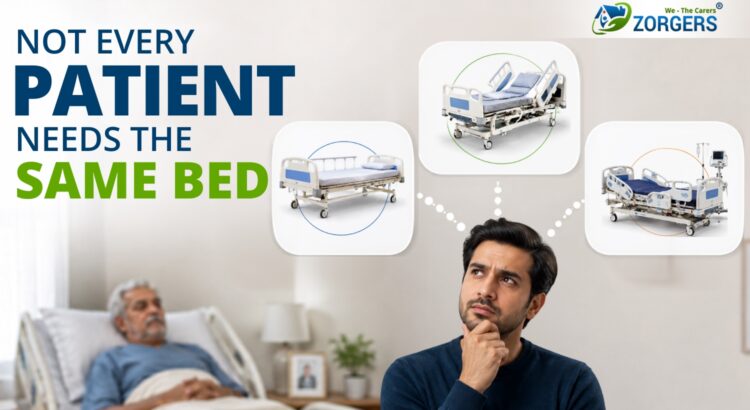
The call usually starts the same way. Someone’s father just got discharged, or their mother’s mobility has suddenly dropped, and the first question is always: “Which bed should we get?” It sounds like a small decision, but it isn’t the right bed can mean a smoother recovery and a caregiver who isn’t exhausted by the end of the week; the wrong one can mean bedsores, sleepless nights, and a lot of trial and error. This guide walks through it plainly, matched to what the patient actually needs, whether you’re renting or buying.
Quick Answer: The right hospital bed depends on how much the patient can move on their own and how much care they need at home. Patients who are mostly independent do fine with a Basic or Fowler bed. Patients who need frequent position changes, but can’t be manually adjusted every time, need a Motorized (One/Two/Three Function) bed. Critically ill patients on a ventilator or under continuous monitoring need an ICU bed. If a caregiver needs to sleep beside the patient overnight, go for the ABS (Attendant Bed System) variant. Bedridden patients who can’t reach the bathroom need a Commode bed, and any bedridden patient should have an Air Mattress to prevent bedsores.
Table of Contents
- 1. Why the Right Bed Choice Matters
- 2. Patient Bed Types Explained
- 3. How to Choose: Match the Bed to the Patient’s Condition
- 4. Which Bed Suits Which Patient Quick Reference
- 5. Key Takeaways
- 6. Frequently Asked Questions
Why the Right Bed Choice Matters
Picture this: a bedridden patient ends up on the wrong bed, and within a couple of weeks you’re dealing with bedsores on top of everything else the family is already managing. Or the caregiver is manually cranking a lever ten times a day because the bed can’t do it electrically. A good bed isn’t just furniture it’s one less thing to fight for both the patient and whoever’s caring for them. That’s why we’re breaking each bed type down by what it actually solves, not just its feature list. The full range is available for rent or purchase here, with next-day delivery and no hidden deposit charges.
Patient Bed Types Explained
1. Basic Hospital Bed
A basic hospital bed is a non-motorized, hand-crank bed suited to patients who can largely move on their own. It’s the simplest option out there for patients who are mostly independent but want a proper hospital-style bed at home for comfort or hygiene. A solid starting point for general elderly care or short-term recovery after a hospital stay.
2. Basic Hospital Bed with ABS
A Basic bed with ABS adds an attendant sleeping panel for a caregiver staying overnight. It’s essentially the same bed, with a fold-out space built in so a family member or hired caregiver can sleep close by. If someone needs to be there through the night, this is the one to get.
3. Fowler Hospital Bed
A Fowler bed has an adjustable backrest that raises the patient into a semi-sitting position. It makes eating, breathing, and just resting comfortably a lot easier. Well suited to patients recovering from surgery or dealing with respiratory issues.
4. Fowler Patient Bed with ABS
This combines the Fowler backrest with an attendant sleeping space for caregivers. Good for semi-dependent patients who need frequent backrest adjustments and a caregiver staying close by through the night.
5. One Function Motorized Patient Bed
A One Function Motorized bed adjusts the backrest electrically via remote control. Useful when the patient or an elderly caregiver can’t handle a manual crank, or when the backrest needs adjusting several times a day.
6. Two Function Motorized Patient Bed
A Two Function Motorized bed electrically adjusts both the backrest and the knee section. A better fit for bedridden patients who need more frequent repositioning to stay comfortable and avoid pressure building up in one spot.
7. Three Function Motorized Patient Bed / ICU Bed
A Three Function Motorized bed gives full electric control over backrest, knee section, and bed height. Suited to post-surgery, stroke, or Parkinson’s patients who need precise repositioning without the caregiver having to lift a finger, literally.
8. ICU Patient Bed
An ICU bed for home care is a critical-care grade bed built to support ventilators, monitors, and IV stands. For patients on a ventilator, with a tracheostomy, or needing continuous critical monitoring at home this is what Zorgers’ L3 Advanced/Critical Care@Home cases fall under.
9. Motorized Recliner Patient Bed
A Motorized Recliner bed electrically shifts between a flat bed and a chair-like sitting position. Good for elderly or semi-mobile patients who want to move between lying down and sitting up without needing to be physically lifted.
10. Fowler Motorised Recliner Patient Bed
This combines Fowler backrest adjustment with motorized recliner movement in one bed. A versatile pick for semi-mobile patients who want both comfort and easy repositioning without compromise.
11. Commode Hospital Bed
A Commode bed has a built-in cutout that lets a bedridden patient use the toilet in bed. It keeps things dignified without needing to walk to the bathroom, and takes a lot of the lifting strain off the caregiver too. Meant for patients who genuinely can’t walk at all.
12. Air Mattress
An air mattress is an add-on, not a bed, that prevents bedsores through alternating pressure relief. It sits on top of the bed and keeps shifting pressure points throughout the day essential for anyone who’s lying down for most of it.
How to Choose: Match the Bed to the Patient’s Condition
- Mostly independent, needs occasional rest: Basic or Fowler bed
- Needs a caregiver staying overnight: Basic or Fowler bed with ABS
- Bedridden, needs frequent repositioning: One/Two/Three Function Motorized bed
- Wants to move easily between lying and sitting: Motorized Recliner or Fowler Motorised Recliner
- Can’t walk to the bathroom: Commode Hospital Bed
- On a ventilator, tracheostomy, or critical monitoring: ICU Patient Bed
- Any bedridden patient, regardless of bed type: add an Air Mattress to keep bedsores off the table
Which Bed Suits Which Patient – Quick Reference
| Bed Type | Best For |
|---|---|
| Basic Hospital Bed | Independent patients, general rest |
| Basic Hospital Bed with ABS | Same, with overnight attendant space |
| Fowler Hospital Bed | Needs backrest support to sit up |
| Fowler Patient Bed with ABS | Semi-dependent, attendant staying over |
| One Function Motorized | Frequent backrest changes, remote control |
| Two Function Motorized | Bedridden, needs frequent repositioning |
| Three Function Motorized / ICU Bed | Post-surgery, stroke, Parkinson’s |
| ICU Patient Bed | Ventilator, tracheostomy, critical care |
| Motorized Recliner | Easy bed-to-chair transitions |
| Fowler Motorised Recliner | Comfort + easy repositioning |
| Commode Hospital Bed | Cannot walk to the bathroom |
| Air Mattress | Bedsore prevention (any bedridden patient) |
Key Takeaways
- Bed selection should come down to the patient’s mobility and care level, not price or brand.
- Manual and Fowler beds work well for independent or semi-independent patients; motorized beds take the physical load off caregivers for bedridden patients.
- ICU beds are only necessary for ventilator, tracheostomy, or continuous critical-monitoring cases.
- An air mattress should go with any bed for a patient who’s bedridden most of the day regardless of which bed type you choose.
- Every bed type here is available on rent or purchase, with home delivery and installation included.
Frequently Asked Questions
Q.1 What does ABS mean in a hospital bed?
ABS stands for Attendant Bed System a fold-out extension attached to the patient’s bed where a caregiver can sleep close by. It comes in handy when someone needs to stay with the patient overnight.
Q.2 What is a Fowler bed used for?
A Fowler bed lets the backrest rise into a semi-sitting position, which helps with breathing, eating, and general comfort especially for patients recovering from surgery or dealing with respiratory issues.
Q.3 What's the difference between One, Two, and Three Function Motorized beds?
The “function” count refers to how many sections move electrically. One Function adjusts just the backrest, Two Function adds the knee section, and Three Function also adjusts bed height. More functions mean less manual effort for the caregiver.
Q.4 Do I need an air mattress with any of these beds?
If the patient is bedridden for most of the day, Yes an air mattress significantly cuts down the risk of bedsores, no matter which bed type you go with.
Q.5 Can I rent a hospital bed instead of buying?
Definitely all these bed types are available on rent or sale, with next-day delivery and no hidden deposit charges.
Related Reads: Exploring the Benefits of Different Types of Hospital Beds · Benefits of Hospital Beds at Home After Knee Replacement
Still not sure which bed fits your patient’s situation? Zorgers’ care team can assess the patient’s condition and point you to the right one. Call the helpline at +91 8725024124 or WhatsApp +91 70876 02000. #WeTheCarers