

Dementia is one of the most misunderstood conditions in elderly care often mistaken for “normal aging” until symptoms become impossible to ignore. Understanding what it actually is, how it affects the brain, and which early signs to watch for can make a significant difference in how early families seek support and intervention.
Quick Answer
Dementia is a neurological condition caused by the progressive destruction of brain cells. It isn’t a single disease but a group of symptoms including memory loss, communication difficulty, impaired judgment, and personality changes that gradually affect a person’s ability to carry out daily activities. Research shows that after age 65, the risk of developing dementia increases significantly.
In This Article :
- What Is Dementia?
- How Dementia Affects Brain Function
- Early Signs & Symptoms
- How Symptoms Affect Daily Life (ADL)
- Frequently Asked Questions
What Is Dementia?
Dementia is a neurological disease involving the progressive destruction of brain cells. Rather than being one specific illness, it’s an umbrella term for a group of symptoms caused by underlying changes in the brain leading to a steady decline in cognitive function.
Over time, this decline affects a person’s ability to carry out their normal Activities of Daily Living (ADL) from basic self-care to more complex tasks like managing finances or following a conversation.
Age is the single biggest risk factor: research shows that once a person crosses 65 years, their chances of developing dementia increase significantly, which is why early monitoring becomes especially important for seniors in this age group.
How Dementia Affects Brain Function
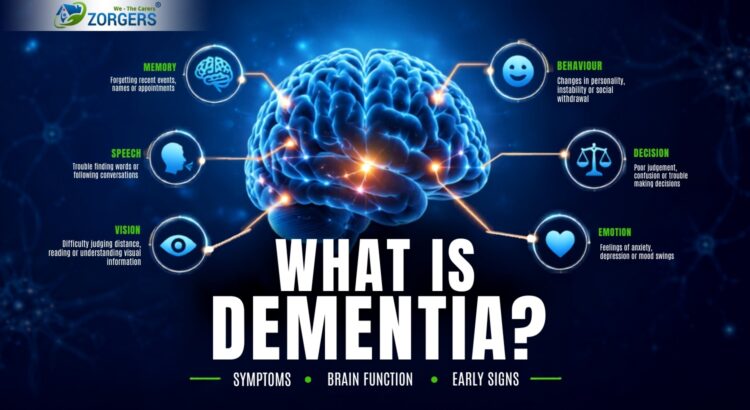
To understand dementia, it helps to understand the brain itself first. The brain is made up of specialized regions commonly grouped into lobes each responsible for different functions: memory, language, reasoning, movement, and personality among them. Brain cells, or neurons, communicate with each other through a complex network of connections.
Dementia progressively damages these neurons and disrupts the connections between them. As different brain regions are affected, the symptoms that appear tend to reflect whichever function that region controls which is why dementia can look different from one patient to another, even though the underlying process is similar.
Early Signs & Symptoms
The earliest signs of dementia are often subtle and easy to dismiss as normal forgetfulness. Families should watch for:
- Memory loss, especially of recent events – forgetting names, appointments, or recent conversations more frequently than before
- Increasing confusion – about time, place, or familiar routines
- Difficulty recognizing familiar people, places, or activities
- Communication difficulty – using the wrong word, misplacing words mid-sentence, or struggling to find the right word at all
These early signs are the ones most often mistaken for “just getting older” but a pattern of worsening memory and communication difficulty, rather than occasional forgetfulness, is what typically distinguishes early dementia from normal aging.
How Symptoms Affect Daily Life (ADL)
As dementia progresses beyond the early stage, its impact extends well beyond memory:
- Impaired judgment and decision-making – difficulty analyzing situations and finding solutions to everyday problems
- Personality and mood changes – mood swings, depression, and social withdrawal
- Difficulty with routine tasks – dressing, cooking, managing personal finances, driving, or going out
- Sensory decline – loss of speech, or hearing and vision impairment
- Gradual loss of independence – increasing reliance on family or caregivers for daily support
This is usually the stage where families start actively looking for structured support whether that’s a trained attendant for daily supervision, a nurse for medical needs, or a dementia-specific care plan that adapts as the condition progresses.
If you’re noticing these signs in a loved one, Zorgers dementia care at home service offers trained caregivers and nurses who understand these exact symptom patterns, with care plans built around the specific stage of the condition.
Key Takeaways
- Dementia is a group of symptoms caused by progressive brain cell damage not a single disease, and not a normal part of aging.
- Risk increases significantly after age 65.
- Early signs recent memory loss, confusion, and communication difficulty are often mistaken for normal forgetfulness.
- As the condition progresses, it affects judgment, personality, daily task performance, and eventually independence.
- Recognizing symptoms early allows families to plan care sooner, which generally leads to better outcomes.
Frequently Asked Questions
Q.1 What is dementia in simple terms?
Dementia is a neurological condition caused by progressive damage to brain cells, leading to a decline in memory, thinking, and the ability to perform daily activities. It’s a group of symptoms rather than one specific disease.
Q.2 What are the earliest signs of dementia?
The earliest signs typically include memory loss for recent events, increasing confusion, difficulty recognizing familiar people or places, and trouble finding the right words during conversation.
Q.3 At what age does dementia risk increase?
Research shows that dementia risk increases significantly after age 65, making this the age when families should start paying closer attention to early warning signs.
Q.4 How is dementia different from normal aging?
Occasional forgetfulness is common with age, but dementia involves a consistent, worsening pattern of memory loss, confusion, and communication difficulty that increasingly interferes with daily activities.
Q.5 How does dementia affect the brain?
Dementia causes progressive damage to brain cells (neurons) and disrupts the connections between them. Because different brain regions control different functions, the specific symptoms that appear depend on which areas are most affected.