


Quick Answer
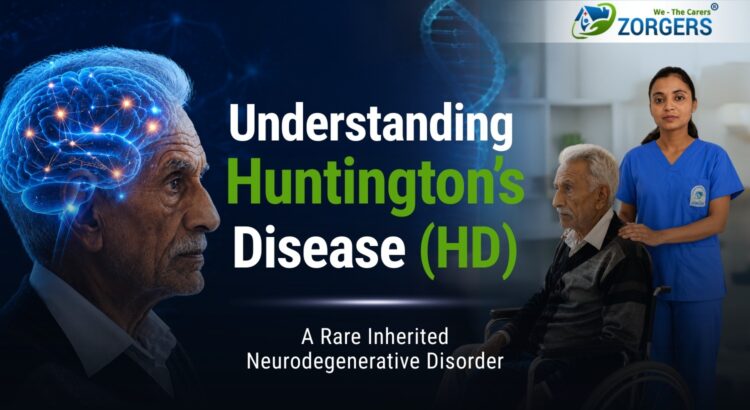
Huntington’s Disease (HD) is a rare, inherited neurodegenerative disorder that causes nerve cells in the brain to gradually break down. Huntington’s Disease affects a person’s movement, thinking ability, and mental health, and is passed down through a changed gene from a parent. Symptoms of Huntington’s Disease most often begin in a person’s 30s or 40s — though a faster-progressing juvenile form can appear before age 20. Medicines can help manage symptoms, but no treatment can currently stop the underlying decline. Structured home-based care becomes increasingly important as the disease progresses.
Key Takeaways
- Huntington’s Disease is a genetic neurological disorder passed down from a parent.
- It affects movement, thinking ability, and mental health — often gradually, over years.
- Symptoms typically begin in a person’s 30s or 40s; a rarer juvenile form can appear before age 20.
- There’s no cure yet, but medication and therapy can help manage symptoms.
- Early support and specialized home care can significantly improve a patient’s quality of life.
Table of Contents
- What is Huntington’s Disease?
- Causes: The Genetics Behind HD
- Symptoms of Huntington’s Disease
- Stages of Huntington’s Disease
- How is HD Diagnosed?
- Treatment and Management
- How Home Care Helps HD Patients
- Frequently Asked Questions
What is Huntington’s Disease?
Huntington’s Disease is a hereditary brain disorder that causes nerve cells in the brain to decay over time. As this decay progresses, it affects a person’s movements, thinking ability, and mental health — often in ways that build gradually rather than appear all at once.
HD is considered rare, but because it’s inherited through a changed gene passed down from a parent, it tends to reappear across generations within the same family. Its progression shares some similarities with other neurodegenerative conditions like Parkinson’s Disease, dementia, or post-stroke recovery, where symptoms evolve in stages over months and years.
Causes: The Genetics Behind HD
Huntington’s Disease is caused by a mutation in the HTT gene, which is responsible for producing a protein called huntingtin. In people with HD, a segment of this gene’s DNA repeats far more times than normal, and this abnormal repeat gradually damages nerve cells in the areas of the brain that control movement, thought, and emotion.
HD follows an autosomal dominant inheritance pattern — meaning a child of a parent carrying the changed gene has a 50% chance of inheriting Huntington’s Disease themselves.
Symptoms of Huntington’s Disease
Huntington’s Disease typically causes a combination of movement disorders, cognitive difficulties, and mental health conditions. The first symptoms — and how severe they are — vary widely from person to person, and their intensity can change as the disease progresses.
Movement Disorders
The movement symptoms of HD are often linked to chorea — involuntary movements that can affect the arms, legs, face, and tongue. Movement-related symptoms can include:
- Involuntary jerking or writhing movements
- Muscle rigidity or muscle contracture
- Slow or unusual eye movements
- Trouble walking or maintaining posture and balance
- Difficulty with speech or swallowing
Beyond the involuntary movements, many people with HD also struggle to control voluntary movements — and this often has an even greater impact on daily life, affecting a person’s ability to work, manage everyday tasks, communicate, and stay independent.
Cognitive Conditions
HD frequently affects cognitive skills — the way a person thinks, plans, and processes information. Common cognitive symptoms include:
- Trouble organizing, prioritizing, or focusing on tasks
- Getting stuck on a particular thought, behavior, or action (known as perseveration)
- Reduced impulse control, which can lead to outbursts or acting without thinking
- Reduced awareness of one’s own behaviors and abilities
- Slower thought processing or difficulty finding the right words
- Trouble learning new information
Mental Health Conditions
The most common mental health condition linked to Huntington’s Disease is depression. Importantly, this isn’t simply an emotional reaction to receiving the diagnosis — it stems from actual damage to the brain and changes in brain function. Symptoms of depression in HD can include irritability, sadness or apathy, social withdrawal, trouble sleeping, fatigue and loss of energy, and in more serious cases, thoughts of death or dying.
Other mental health conditions that can accompany HD include:
- Obsessive-compulsive patterns — intrusive thoughts that keep recurring, along with repeated behaviors
- Mania — elevated mood, overactivity, impulsive behavior, and inflated self-esteem
- Bipolar-type mood swings — alternating episodes of depression and mania
Unintended weight loss is also common in people with HD, especially as the disease advances.
Symptoms of Juvenile Huntington’s Disease
When HD develops before age 20, it’s classified as juvenile Huntington’s disease. It begins and progresses somewhat differently than the adult-onset form, often moving faster. Early signs can include:
Behavioral changes:
- Trouble paying attention
- A sudden drop in overall school performance
- Behavioral issues, such as aggression or disruptiveness
Physical changes:
- Contracted, rigid muscles that affect walking, especially in young children
- Slight involuntary movements, known as tremors
- Frequent falls or clumsiness
- Seizures
Most people, however, don’t develop symptoms this early — HD typically begins when someone is in their 30s or 40s.
Stages of Huntington’s Disease
HD generally progresses through three broad stages, though every patient’s timeline looks a little different:
- Early stage: Mild changes in coordination, occasional involuntary movements, and subtle shifts in mood or cognitive function. Most patients are still largely independent.
- Middle stage: Movement and speech become noticeably harder, cognitive decline deepens, and the patient increasingly depends on caregivers for daily activities.
- Late stage: Significant physical and cognitive impairment. Patients require full-time care, including help with mobility, feeding, and personal hygiene.
How is HD Diagnosed?
Diagnosing Huntington’s Disease typically involves a combination of:
- A detailed neurological examination
- A thorough review of family medical history
- Genetic testing to confirm the HTT gene mutation
- Brain imaging (MRI or CT scans) to assess structural changes
Genetic counseling is strongly recommended for individuals with a family history of HD — especially before planning a family, given the 50% inheritance risk.
Treatment and Management
There is currently no cure for Huntington’s Disease. Medicines are available to help manage symptoms such as chorea, mood changes, and psychiatric issues, but treatment cannot prevent the physical, mental, and behavioral decline that HD causes over time. Because of this, a well-rounded management approach matters:
- Medications to help control involuntary movements and manage mood or psychiatric symptoms
- Physiotherapy to maintain mobility and reduce fall risk — our at-home physiotherapy services are built for exactly this kind of ongoing support
- Speech and swallowing therapy as motor symptoms progress
- Occupational therapy to support day-to-day independence
- Psychological support for both the patient and family caregivers
Managing HD symptoms can be overwhelming for families. Zorgers’ trained nurses and caregivers can support your loved one at home — from daily assistance to advanced medical care. Talk to our care team or call +91 8725024124 to know more.
How Home Care Helps HD Patients
As Huntington’s Disease progresses, patients need increasing support with daily routines, mobility, medication management, and emotional wellbeing. Professional home-based care allows patients to remain in a familiar, comfortable environment while receiving consistent, trained support — something that becomes especially valuable given how gradually and unpredictably HD can progress.
At Zorgers, our care plans are structured to match the patient’s stage of need. Explore our full elderly home care services, including dedicated patient care at home and nursing care at home:
- L1 – Assisted Living/Companionship: Daily assistance, bathing and toileting support, meal support, and medication reminders for early-stage patients
- L2 – Post-Hospital/Bed Ridden Care: RT feeding, oxygen support, injections, and vitals monitoring for middle-stage patients with greater dependency
- L3 – Advanced/Critical Care at Home: Ventilator support, tracheostomy care, suctioning, BiPAP/CPAP, catheter, and stoma care for late-stage patients
If mobility becomes a concern at any stage, our wheelchair and mobility equipment rental options can help patients move around safely at home.
Our trained nurses and caregivers work closely with families to ensure HD patients receive dignified, consistent, and medically sound care at every stage of the disease.
Frequently Asked Questions
Can Huntington's Disease patients live a normal life?
Many people with Huntington’s Disease can live independently and manage daily activities for years, especially in the early stages. As symptoms progress, though, day-to-day life does change — movement, communication, and thinking become harder, and support needs grow. With the right combination of medical treatment, therapy, and home care, patients can still maintain dignity, comfort, and a good quality of life at every stage.
How can caregivers manage Huntington's Disease at home?
Caregiving for HD works best with a structured routine — consistent meal times, medication schedules, and physical activity all help. It also helps to adapt the home environment for safety (removing fall hazards, adding support rails), stay patient with communication difficulties, and get professional support for tasks like feeding, mobility, or personal care as the disease advances. Caregiver burnout is common with HD, so leaning on trained home care support and psychological counseling isn’t just helpful for the patient — it protects the caregiver’s wellbeing too.
What is the life expectancy of Huntington's Disease?
On average, people live around 10 to 20 years after symptoms first appear, though this varies quite a bit from person to person. Factors like age of onset, how quickly the disease progresses, and the quality of medical and home care received all play a role. Juvenile Huntington’s Disease tends to progress faster, which can affect life expectancy differently than the adult-onset form.
What causes Huntington's Disease?
Huntington’s Disease is caused by a mutation in the HTT gene, which is inherited from a parent. This mutation leads to the gradual breakdown of nerve cells in the brain, affecting movement, cognition, and mental health.
What is juvenile Huntington's Disease?
Juvenile Huntington’s Disease is when HD develops before age 20. It tends to progress faster than the adult-onset form, with early signs that can include trouble focusing, a sudden drop in school performance, behavioral changes, muscle rigidity, tremors, frequent falls, and in some cases, seizures.
Is Huntington's Disease common in India?
No, Huntington’s Disease is considered rare in India, though exact prevalence data is limited. Because it’s inherited, it tends to run in families where the gene has been passed down.
Can Huntington's Disease be prevented?
HD cannot be prevented once the gene mutation is inherited. However, genetic testing and counseling can help individuals with a family history understand their risk and make informed family planning decisions.
At what age do Huntington's Disease symptoms usually appear?
Most people develop symptoms in their 30s or 40s, though a rarer juvenile form can appear before age 20.
Does Zorgers provide home care for Huntington's Disease patients?
Yes. Zorgers offers tiered home care plans (L1, L2, L3) covering everything from daily assistance to advanced critical care, tailored to the patient’s stage of Huntington’s Disease.
Looking for professional home care support for a loved one with Huntington’s Disease?
Call our helpline at +91 8725024124 or reach us on WhatsApp at +91 70876 02000. You can also get in touch with our care team or email us at enquiry@zorgers.com.
#WeTheCarers