
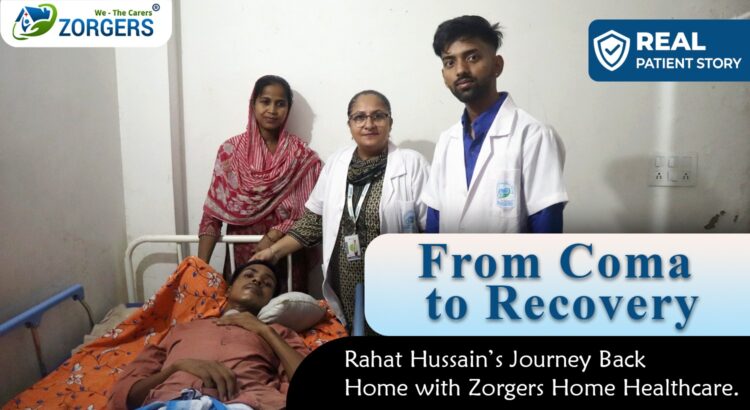
In short: Rahat suffered a head injury and mandible fracture in an accident, went into a coma, and was placed under home-based critical care with tracheostomy, feeding tube, and catheter support. Five months of consistent nursing care and family support later, he regained movement, speech, and full independence – and went home.
What Happened: A Sudden Accident, A Sudden Coma :
Rahat Hussain worked as a labourer with a construction company. While returning from duty one evening, he met with a serious accident. The injuries were severe – a mandible (jaw) fracture and a significant head injury that left him in an altered state of consciousness, and soon after, in a coma.
When Zorgers Home Healthcare onboarded Rahat almost five months ago, his condition was critical:
- He had a tracheostomy tube (TT) in place
- A Ryle’s Tube (RT) for feeding
- A urinary catheter
- Continuous intravenous medication support
He was not conscious of his surroundings, could not move his limbs, and had no ability to communicate. For any family, this is one of the most frightening phases of a medical crisis.
The Road to Recovery: What Home-Based Critical Care Looked Like :
Recovery from a coma is rarely a single moment – it is built day by day through consistent, skilled, and compassionate care. For Rahat, this meant round-the-clock support from Zorgers’ ICU care at home team, including caregivers Mr. Raza and Mr. Aditya Kumar, who monitored him closely over the months.
Step by step, the signs of progress appeared:
- Tracheostomy tube (TT) removed – a major milestone indicating stable, independent breathing
- Urinary catheter removed – signaling improved bladder control and neurological recovery
- Ryle’s Tube (NG) removed – meaning Rahat could finally eat and swallow on his own again
- Limb movement returned – from complete immobility to controlled movement of hands and legs
- Speech returned – from silence to clear, confident conversation
As his nursing caregiver Aditya recalls,
“Pehle jab iska accident hua tha, ye pair hila nahi pa rahe the. But ab toh proper bol pa rahe hain.”
A Family’s Strength, A Caregiving Team’s Dedication :
Medical equipment and clinical protocols matter – but recovery like this is equally about human connection. Rahat’s family stayed by his side throughout the five-month journey, and his caregiving team treated him with the attention a case like this demands.
His mother shared her relief in her own words:
“Pehle mera ladka khaana nahi kha pata tha, gala nahi hila pata tha. Ab mera bachcha sahi se khaana khaata hai, baithta hai, uthta hai , sab kuch theek hai.”
Why This Recovery Matters for Other Families :
Cases like Rahat’s answer something many families quietly wonder about when a loved one is in a coma: is recovery only possible in a hospital ICU, or can it happen at home? With the right clinical setup and a trained team, home-based recovery is very much possible.
Home-based critical patient care can include:
- Tracheostomy and ventilator management
- Ryle’s Tube / NG tube feeding and monitoring
- Catheter care and hygiene protocols
- Neurological monitoring and physiotherapy support
- Regular medical review and escalation planning
This approach also means the patient is surrounded by family in a familiar environment – something that plays a meaningful role in neurological and emotional recovery, alongside clinical treatment.
Watch Rahat’s Story :
Frequently Asked Questions :
Q.1 Can a coma patient recover at home instead of a hospital ICU?
Yes, in many stable cases, coma and post-coma recovery can be managed at home with the right clinical setup including tracheostomy care, feeding tube management, catheter care, and regular medical monitoring by trained home healthcare staff.
Q.2 How long does coma recovery take?
Recovery time varies significantly based on the severity of the head injury, the patient’s overall health, and the consistency of care received. Some patients show progress within weeks, while others, like Rahat, may need several months of dedicated support.
Q.3 What equipment is needed for home care after a coma?
Depending on the patient’s condition, this may include tracheostomy care supplies, Ryle’s Tube/NG feeding setup, catheter care items, oxygen support, and monitoring equipment all of which can be arranged and managed by a home healthcare provider.
Q.4 What signs indicate a coma patient is recovering?
Common positive signs include return of limb movement, ability to swallow (allowing feeding tube removal), stable independent breathing (allowing tracheostomy tube removal), bladder control (allowing catheter removal), and eventually, speech.
Q.5 How much does home care cost compared to staying in a hospital ICU?
Home-based critical care is generally more cost-effective than an extended hospital ICU stay, since it avoids daily bed charges and hospital overheads while still providing tracheostomy care, feeding support, catheter management, and nursing supervision. Exact costs depend on the level of care and duration required.
Q.6 What role does family support play in coma recovery?
Family presence and involvement can meaningfully support a patient’s emotional and neurological recovery. Being in a familiar environment, hearing familiar voices, and having consistent family involvement alongside professional nursing care often contributes positively to the recovery process.
Q.7 When can a tracheostomy tube, catheter, or feeding tube be safely removed?
These are typically removed once the patient shows stable independent breathing (for tracheostomy), regained bladder control (for catheter), and the ability to swallow safely (for feeding tube). This is assessed and decided by the treating medical team based on the patient’s progress.
Q.8 Is physiotherapy needed after coming out of a coma?
Yes, physiotherapy is often an important part of recovery, especially for regaining limb movement, mobility, and muscle strength that may have been lost during the period of unconsciousness and immobility.
How Zorgers Home Healthcare Can Help Your Family
If your family is navigating a critical care situation whether it’s post-coma recovery, ventilator dependency, or complex home nursing needs Zorgers Home Healthcare provides trained ICU-level care at home across Delhi, Gurugram, Chandigarh, Mohali, Panchkula, Noida, Ludhiana, and Jalandhar.
Explore related services:
Call our helpline: +91 8725024124
WhatsApp: +91 70876 02000
Email: enquiry@zorgers.com
Zorgers Home Healthcare ISO 9001:2015 certified, Government of India recognised, serving 10,000+ patients with a 4.8★ Google rating since 2013.