

Quick Facts About Ventilator Care at Home
- Suitable for post-ICU, chronic respiratory, and neurological patients
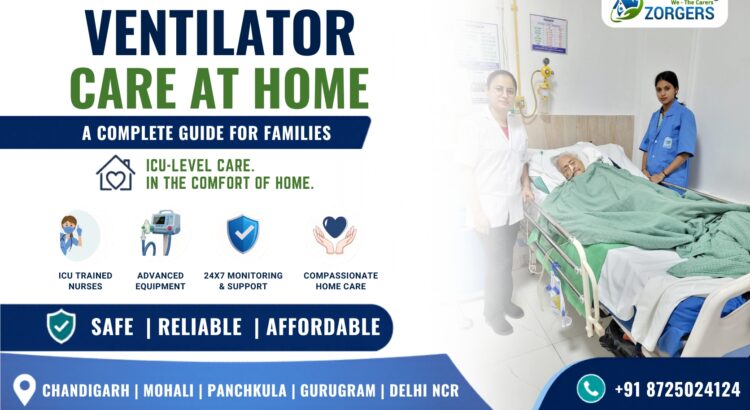
- ICU-grade ventilator and monitoring equipment delivered to home
- Managed by critical-care trained nurses on 12 or 24-hour shifts
- 24×7 monitoring, tele-support, and emergency escalation available
- Significantly lower infection risk than a prolonged hospital ICU stay
- Supports gradual ventilator weaning under physician supervision
- Available across Chandigarh, Mohali, Panchkula, Gurugram, and Delhi NCR
When a loved one is discharged from the hospital still dependent on a ventilator, the question every family faces is the same — what next? Returning home feels impossible, yet extending a hospital stay is financially and emotionally draining. This is exactly where Ventilator Care at Home steps in as a medically sound, compassionate, and practical solution.
Across Chandigarh, Mohali, Panchkula, Gurugram, and Delhi NCR, more families are now choosing structured home-based ventilator management over prolonged ICU stays — not as a compromise, but as a deliberate, well-supported care decision.
What Is Ventilator Care at Home?
Ventilator care at home refers to the clinical management of a patient who requires mechanical ventilation — either invasive (through a tracheostomy or endotracheal tube) or non-invasive (via BiPAP or CPAP) — within a home environment. It replicates the monitoring, interventions, and emergency readiness of a hospital ICU, but within the familiarity and comfort of the patient’s own space.
This is not an informal arrangement. A properly structured Ventilator Care at Home setup involves a critical-care trained nurse, hospital-grade equipment, a supervising physician, and an escalation protocol in case of emergencies — every element that makes ICU care safe is carried into the home.
Who Needs Ventilator Care at Home?
Not every ventilator-dependent patient is the same. Home-based ventilator management is suitable for a wide range of conditions:
Post-ICU Step-Down Patients — Patients who have been stabilised in the hospital ICU but continue to require ventilatory support, oxygen titration, or airway management. They are too stable for the ICU but too critical for general ward or home without medical backup.
Chronic Respiratory Conditions — Patients with advanced COPD, interstitial lung disease, or chronic respiratory failure who need long-term BiPAP or CPAP support alongside nursing care at home.
Neurological and Neurosurgical Cases — Patients recovering from severe stroke, traumatic brain injury, spinal cord injury, or post-neurosurgery who have compromised respiratory drive and require ventilatory assistance alongside tracheostomy care. For these patients, combining ventilator care at home with stroke care at home or neuro physiotherapy at home produces significantly better outcomes.
ALS / Motor Neuron Disease Patients — As the disease progresses, patients lose the ability to breathe independently. Home ventilator care allows these individuals to remain with family for as long as possible, with dignity and clinical safety.
Palliative and End-Stage Patients — For patients with terminal cancer or advanced organ failure, ventilator support at home is often part of a broader palliative care at home plan focused on comfort rather than cure.
What Does a Safe Home Ventilator Setup Include?
A clinically safe Ventilator Care at Home setup is not just about the machine. It is a complete ecosystem of equipment, trained personnel, and protocols working together.
Equipment: Hospital-grade ventilator (invasive/non-invasive), BiPAP/CPAP as backup or primary support, cardiac and multipara monitors, suction machine, infusion and syringe pumps, oxygen concentrator and cylinder with backup, air mattress for pressure sore prevention, pulse oximeter, and emergency drug kit as per physician orders.
Nursing Care: A critical-care trained ICU nurse manages ventilator settings, circuit checks, suction, humidification, tracheostomy care, NG/PEG tube feeding, IV/IM medications, and meticulous vitals charting every 1–2 hours. The nurse also monitors for early signs of respiratory distress, circuit disconnection, or infection, and initiates the escalation protocol when required.
Medical Supervision: A supervising physician reviews the care plan, adjusts ventilator parameters when needed, and coordinates with the treating hospital. Nursing supervisors conduct regular audits and tele-calls to ensure care quality. Doctor visits at home can also be arranged for bedside review.
Emergency Readiness: A written escalation protocol, 24×7 tele-support helpline, and pre-linked ambulance service ensure that any deterioration is met with an immediate, coordinated response.
Ventilator Care at Home vs Hospital ICU — How Do They Compare?
Families often worry that choosing home over hospital means compromising on safety. When structured correctly, home ventilator care matches hospital-level clinical monitoring while offering several advantages that a hospital simply cannot:
Cost: Home-based ventilator care at home typically costs 40–60% less than an equivalent hospital ICU stay, without hidden charges for room upgrades, attendant passes, or daily consumables billed at marked-up rates.
Infection Risk: Hospital-acquired infections — including ventilator-associated pneumonia (VAP) — are among the most serious risks for ICU patients. At home, the controlled single-patient environment dramatically reduces this risk.
Nurse Attention: In a hospital ICU, one nurse typically manages 2–4 patients simultaneously. At home, your patient receives one-to-one critical care nursing attention through every shift.
Family Presence: Families can be present continuously, participate in care decisions, and provide the emotional comfort that accelerates recovery — something hospital visiting hours rarely allow.
Continuity of Care: The same physician can continue supervising the case from home, eliminating the confusion of multiple handovers. Physiotherapy at home and lab diagnostics at home can be integrated seamlessly into the care plan.
Ventilator Weaning at Home — Is It Possible?
Yes. For many patients, the goal of home ventilator care is gradual weaning — progressively reducing the patient’s dependence on the ventilator as their respiratory muscles strengthen and the underlying condition improves.
Weaning at home is a carefully supervised process. The nurse monitors the patient’s breathing effort, oxygen saturation, heart rate, and tolerance during periods of spontaneous breathing. The physician adjusts weaning parameters remotely or through doctor visits at home. When combined with chest physiotherapy at home, weaning success rates improve significantly — the physiotherapist works on respiratory muscle strengthening, secretion clearance, and breathing exercises alongside ventilator management.
Cost of Ventilator Care at Home in Chandigarh, Mohali, Panchkula & Gurugram
The cost of ventilator care at home is not a fixed figure — it depends on several clinical and logistical factors specific to each patient. Understanding these helps families plan realistically and avoid surprises.
Factors That Affect the Cost:
Type of Ventilator Required — Invasive ventilators (used with tracheostomy patients) involve more complex management and higher equipment costs than non-invasive support via BiPAP or CPAP.
ICU Nurse Requirement — A 12-hour nursing shift costs less than 24-hour continuous coverage. Patients on invasive ventilation or with high clinical complexity typically require round-the-clock nursing.
Duration of Care — Short-term post-discharge care (2–4 weeks) is priced differently from long-term ventilator management for chronic conditions (months). Longer durations often attract more stable monthly packages.
Additional Equipment — Multipara monitors, infusion pumps, syringe pumps, suction machines, oxygen backup cylinders, and air mattresses may be included or priced as add-ons depending on patient needs.
Doctor Visits and Medical Supervision — Periodic doctor visits at home for ventilator parameter review, case assessment, and prescription updates are part of comprehensive care and may be priced separately.
Location — Setup and travel logistics vary slightly across Chandigarh, Mohali, Panchkula, Gurugram, and Delhi NCR.
As a general reference, home ventilator care costs 40–60% less than a comparable hospital ICU stay when all charges — room, nursing, attendant passes, and consumables — are factored in. Zorgers provides a transparent, itemised quotation after an initial clinical assessment at no obligation.
To get an accurate cost estimate for your patient’s specific situation, call (+91) 8725024124 or WhatsApp at 7087602000.
How Ventilator Care at Home Is Set Up — Step by Step
Step 1 — Clinical Assessment: A detailed review of the patient’s diagnosis, current ventilator settings, nursing requirements, and home environment is conducted. Family education begins at this stage.
Step 2 — Care Plan and Quotation: Nurse coverage hours, equipment list, medication protocols, and escalation plan are finalised. A clear, transparent quotation is provided with no hidden charges.
Step 3 — Home Visit and Equipment Setup: ICU equipment is delivered, installed, and tested in the patient’s room. The nurse and family are trained on emergency procedures including manual bagging, circuit disconnect management, and suction.
Step 4 — Nurse Deployment: The critical-care nurse takes charge, begins vitals charting, and establishes the care routine. A handover from the hospital team is conducted when applicable.
Step 5 — Ongoing Monitoring and Review: 24×7 helpline support, regular nursing supervisor audits, periodic physician reviews, and tele-monitoring ensure care quality is maintained without interruption.
Why Families Choose Zorgers for Ventilator Care at Home
When it comes to managing a ventilator-dependent patient at home, the provider’s capability is not a secondary consideration — it is the entire difference between safe care and a preventable crisis. Here is why families across North India consistently trust Zorgers:
ICU-Trained Critical Care Nurses — Every nurse deployed for ventilator care has prior ICU experience and is verified for competencies including ventilator management, tracheostomy care, suction, and emergency response. This is not general nursing — it is specialised critical care.
Hospital-Grade Equipment at Home — Zorgers deploys the same class of ventilators, multipara monitors, infusion pumps, and oxygen backup systems used in hospital ICUs. Equipment is tested and installed at home before the patient arrives.
Physician-Led Care Plans — Every ventilator patient is managed under a supervising physician who reviews the care plan, adjusts parameters as the patient progresses, and coordinates with the treating hospital team. Families are not left to make clinical decisions alone.
Rapid Setup — Within 24 Hours — In most cases across Chandigarh, Mohali, Panchkula, Gurugram, and Delhi NCR, a complete home ventilator setup can be deployed within 24 hours of confirmation.
24×7 Medical and Coordination Backup — A dedicated helpline, nursing supervisor on-call, and pre-linked ambulance mean that any escalation is handled immediately, not after a delay.
Integrated Care Under One Roof — Zorgers combines ventilator care at home with physiotherapy, diagnostics at home, doctor visits, and palliative care — eliminating the coordination burden on families.
Transparent Pricing and Documentation — Proper invoices, documentation for insurance claims, and no hidden charges. Families dealing with a medically complex situation do not need financial surprises on top.
Proven Track Record — Rated 4.8 on Google based on 1,000+ reviews. Zorgers is an ISO 9001:2015 certified, Government of India recognised healthcare startup with a 6,000+ caregiver pool and presence across the Tricity and NCR.
Locations Where Ventilator Care at Home Is Available
Zorgers provides Ventilator Care at Home across Chandigarh, Mohali, Panchkula, Gurugram, Delhi, Noida, Ludhiana, Jalandhar, Ambala, and Zirakpur. Equipment delivery and nurse deployment can be arranged within 24 hours of confirmation in most locations.
Frequently Asked Questions — Ventilator Care at Home
Q1. Is ventilator care at home as safe as hospital ICU care?
Yes, when set up by a trained and certified provider. A properly structured home ventilator setup includes ICU-grade equipment, critical-care nursing, physician supervision, and a 24×7 emergency escalation protocol. The single-patient environment also reduces infection risk significantly compared to a hospital ICU.
Q2. Which types of ventilators are used for home care?
Both invasive ventilators (connected through a tracheostomy or endotracheal tube) and non-invasive ventilators (BiPAP/CPAP via mask) are used depending on the patient’s condition. The treating physician determines the appropriate mode and settings, which are maintained and monitored by the home ICU nurse.
Q3. Can a patient be weaned off the ventilator at home?
Yes. Many patients successfully wean off ventilatory support at home under physician supervision and with the support of chest physiotherapy at home. Weaning is a gradual, monitored process that depends on the patient’s respiratory strength, underlying diagnosis, and overall recovery trajectory.
Q4. How long can a patient stay on a ventilator at home?
There is no fixed upper limit. Some patients require ventilator support for a few weeks post-ICU discharge, while others — such as those with ALS, advanced COPD, or spinal cord injury — may need long-term or permanent ventilatory support at home. Duration is determined by the patient’s medical condition and physician assessment, not by the care setting.
Q5. Is 24-hour nursing mandatory for ventilator patients at home?
For patients on invasive mechanical ventilation, 24-hour nursing is strongly recommended and in most cases clinically necessary. For patients on non-invasive support (BiPAP/CPAP) who are otherwise stable, 12-hour nursing coverage may be appropriate — but this is always determined based on the individual patient’s condition and physician guidance.
Q6. Can a tracheostomy patient live at home safely?
Yes, absolutely. Tracheostomy care — including suction, tube care, dressing changes, and secretion management — is a core nursing skill for any ICU nurse deployed for ventilator care at home. Many tracheostomy patients live safely at home for months or years with proper nursing support.
Q7. Can ventilator patients travel?
Short-distance travel is possible for stable ventilator patients with advance planning — typically involving a portable ventilator, oxygen backup, battery support, and a nurse escort. Long-distance or air travel requires extensive coordination with the airline, destination medical team, and equipment supplier. This should always be evaluated and cleared by the treating physician before any travel is attempted.
Q8. What happens in a ventilator emergency at home?
A responsible home ventilator care provider will have a written emergency protocol established before the patient arrives home. This includes a nurse trained in manual bagging, a 24×7 tele-support helpline, a pre-linked ambulance, and clear escalation steps for hospital transfer. Families are trained in basic emergency response as part of the initial setup.
Q9. How much does ventilator care at home cost in Chandigarh, Mohali, Panchkula, or Gurugram?
Cost depends on the type of ventilator, nurse coverage hours, equipment requirements, and patient complexity. It is typically 40–60% lower than a comparable hospital ICU stay. Zorgers provides a transparent, itemised quotation after clinical assessment. Call (+91) 8725024124 for an estimate.
Q10. Is home ventilator care covered by health insurance?
Some insurance policies cover home ICU and ventilator care when prescribed as a medical necessity by the treating physician. Coverage depends on your specific policy, cashless guidelines, and documentation requirements. It is advisable to check with your insurer before setup begins.
Q11. What other services can be combined with ventilator care at home?
Ventilator care at home integrates well with physiotherapy at home, doctor visits at home, diagnostics at home, and palliative care at home — depending on the patient’s diagnosis and recovery stage. A coordinated multi-service care plan consistently produces better outcomes than ventilator management in isolation.