
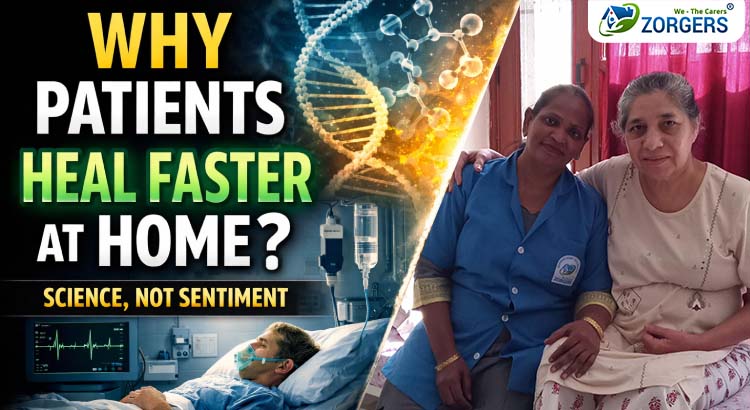
For decades, hospitals have been seen as the default place for recovery. But modern medical research tells a different story.
Across post-surgical care, chronic illness management, and elderly recovery, patients consistently heal faster at home—and not because it feels better, but because science supports it.
Let’s break down why home healing works, backed by physiology, psychology, and clinical outcomes.
1. Lower Stress = Faster Healing (Cortisol Science)
When a patient is hospitalized, the body often stays in a stress-response mode.
- Unfamiliar surroundings
- Constant alarms and noise
- Interrupted sleep cycles
- Loss of privacy and independence
All of this elevates cortisol, the stress hormone.
Why this matters:
High cortisol levels:
- Slow wound healing
- Suppress immune response
- Increase inflammation
- Delay tissue repair
At home, cortisol levels drop naturally because patients feel safe, familiar, and in control. This allows the body to shift from fight-or-flight mode to repair-and-recover mode.
📌 This is not emotional comfort — it’s neuroendocrine biology.
2. Better Sleep Quality Improves Immune Function
Sleep is one of the most critical drivers of recovery.
In hospitals:
- Lights remain on at night
- Vitals are checked frequently
- Noise levels stay high
Studies show hospitalized patients experience fragmented sleep, which directly affects healing.
At home:
- Patients sleep in familiar beds
- Circadian rhythm remains intact
- Deep sleep cycles are longer
Scientific impact:
- Growth hormone (released during deep sleep) accelerates tissue repair
- Immune cells regenerate faster
- Pain tolerance improves
Better sleep = stronger immunity = faster recovery.
3. Reduced Risk of Hospital-Acquired Infections (HAIs)
Hospitals, despite best protocols, expose patients to:
- Drug-resistant bacteria
- Cross-infections
- Recurrent antibiotic use
This is especially risky for:
- Elderly patients
- Post-surgery patients
- Immunocompromised individuals
Home care advantage:
- Controlled environment
- Limited exposure to pathogens
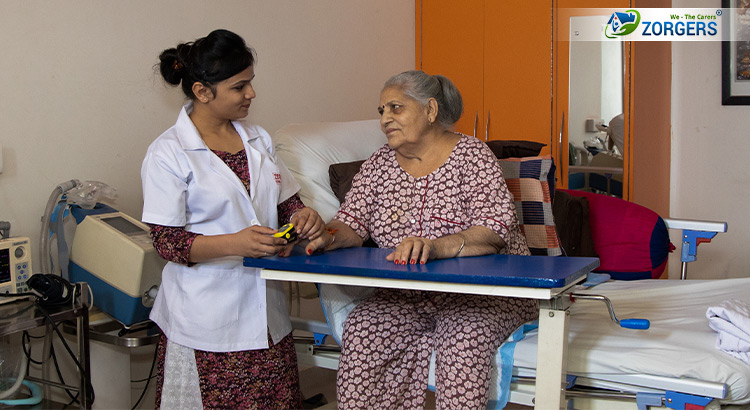
- One-on-one caregiver or nurse attention
📊 Research consistently shows lower infection rates for patients receiving structured home healthcare compared to prolonged hospital stays.
4. Continuity of Care Improves Clinical Outcomes
In hospitals, care often rotates:
- Shift changes
- Multiple nurses
- Multiple doctors
At home:
- Same nurse or caregiver daily
- Consistent monitoring
- Personalized care routines
Why continuity matters:
- Early detection of complications
- Better medication adherence
- Faster response to subtle changes
- This leads to:
- Fewer emergency readmissions
- Better chronic condition control
- Higher patient compliance
5. Emotional Well-Being Directly Affects Physical Recovery
Modern medicine now recognizes the mind–body connection as measurable, not theoretical.
At home, patients experience:
- Familiar faces
- Emotional security
- Family presence
- Sense of dignity and autonomy
Scientific outcomes:
- Reduced anxiety and depression
- Improved appetite and nutrition
- Higher motivation for physiotherapy and movement
Mental stability improves neurological signaling, which supports faster rehabilitation and pain control.
6. Personalized Nutrition and Movement at Home
Hospital meals are standardized. Home meals are personalized.
At home:
- Diet tailored to patient preferences and medical needs
- Movement encouraged naturally (walking, sitting, daily activity)
- Physiotherapy integrated into daily routine
This leads to:
- Better digestion
- Improved muscle strength
- Reduced risk of bedsores and stiffness
7. Fewer Readmissions, Lower Recovery Costs
Data from home healthcare programs shows:
- Reduced hospital readmissions
- Shorter recovery timelines
- Lower overall treatment costs
This is because problems are:
- Detected earlier
- Managed proactively
- Treated before escalation
Healing faster also means healing smarter.
Home Healing Works — When Care Is Structured
It’s important to clarify:
Healing faster at home is not about being left alone.
It works when professional care comes home.
That includes:
- Trained nurses
- Vital monitoring
- Medication management
- Emergency escalation protocols
When home care is clinical, supervised, and personalized, outcomes often surpass institutional recovery.
Final Thought: The Future of Recovery Is Home-Centered
Hospitals save lives.
Homes restore them.
The science is clear:
When patients are medically stable, the human body heals best in an environment it recognizes as safe.
Home healthcare isn’t a compromise.
It’s an evolution.
Looking for Structured Home Healthcare?
At Zorgers, recovery is designed around clinical protocols, trained professionals, and compassionate care—right where healing happens best: home.