
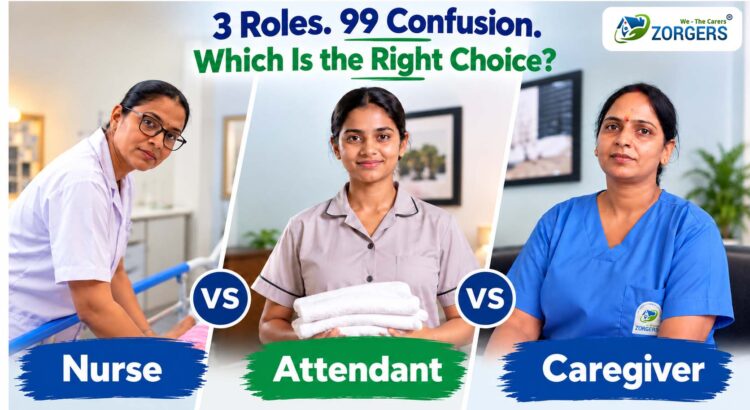
Quick Answer: A nurse is a qualified medical professional who handles clinical care such as injections, IV drips, wound dressing and vitals monitoring. A caregiver supports daily living and companionship: bathing, meals, mobility, medication reminders. A patient attendant mainly provides physical help like lifting, shifting, cleaning and feeding. Choose a nurse when medical procedures are needed, and a caregiver or attendant when the need is daily assistance.
In This Article
- Why families get confused
- Who is a nurse?
- Who is a patient attendant?
- Who is a caregiver?
- Nurse vs attendant vs caregiver: side-by-side
- Which one should you choose?
- Can you combine them?
- How to hire safely
- FAQs
Why Families Get Confused
When a parent comes home from the hospital, or an elderly family member can no longer manage alone, the first question is usually, “Who should we hire?” Agencies, neighbours and job portals use the words nurse, attendant, caregiver, aaya, ward boy and helper almost interchangeably. But the training, the tasks and the responsibility are very different.
Hiring the wrong person can mean paying for skills you do not need, or worse, leaving a medical task to someone who is not trained for it. This guide explains each role in plain language so you can decide with confidence.
Who Is a Nurse?
A nurse is a formally trained healthcare professional. In India this usually means a GNM, ANM or B.Sc Nursing qualification, with registration under the State Nursing Council.
What a home nurse can do
- Give injections and IV fluids as prescribed by a doctor
- Monitor vitals such as BP, pulse, oxygen saturation, temperature and blood sugar
- Wound and pressure sore dressing
- Catheter, stoma, Ryles tube (RT) feeding and tracheostomy care
- Oxygen support, nebulisation and suctioning
- Post-surgery and post-hospital care
- Recognising warning signs and informing the doctor on time
Best for: bedridden patients, post-operative recovery, patients on IV medication, palliative care, and anyone with tubes, wounds or complex medical needs.
Who Is a Patient Attendant?
A patient attendant (sometimes called a home health aide or ward attendant) provides hands-on physical help. They are trained in basic patient handling, but they do not perform clinical procedures.
What an attendant typically does
- Helping the patient turn, sit, stand and walk safely
- Shifting from bed to wheelchair or commode
- Sponge bath, diaper change and general hygiene
- Feeding the patient
- Keeping the bed and room clean
- Repositioning at intervals to reduce bed sores
Best for: patients who are weak or have limited mobility and need physical assistance, but no regular medical procedures.
Who Is a Caregiver?
A caregiver covers the physical help an attendant gives and adds the human side of care: routine, companionship and supervision. This is the role most families need for elderly parents, especially those living with age-related conditions such as dementia, arthritis or general frailty.
What a caregiver typically does
- Help with daily activities: bathing, dressing, toileting and grooming
- Prepare and serve meals as per the diet plan
- Medication reminders (giving pills at the right time, not prescribing or changing them)
- Companionship, conversation and emotional support
- Accompanying the person on walks and to appointments
- Keeping a simple daily log and informing the family if something seems off
Best for: senior citizens who need company, supervision and daily support, including live-in care.
Nurse vs Attendant vs Caregiver: Side-by-Side
| Factor | Nurse | Patient Attendant | Caregiver |
|---|---|---|---|
| Training | GNM / ANM / B.Sc Nursing, council registered | Basic patient handling training | Training in elder care and daily living support |
| Medical procedures | Yes (injections, IV, dressing, catheter, tracheostomy) | No | No |
| Vitals monitoring | Yes, and can interpret and escalate | Basic checks at most | Basic checks and logging |
| Bathing, feeding, hygiene | Yes, if needed | Yes | Yes |
| Companionship | Limited | Limited | A core part of the role |
| Medication | Administers as prescribed | Reminders only | Reminders only |
| Best for | Bedridden, post-surgery, critical care | Low-mobility patients | Elderly care, dementia, long-term support |
Which One Should You Choose?
Choose a nurse if:
- The patient needs injections, IV fluids or wound dressing
- There is a catheter, feeding tube, tracheostomy or oxygen support
- The patient is recently discharged after surgery or a serious illness
- Vitals need close monitoring
Choose an attendant if:
- The patient is weak or has difficulty moving and needs physical help
- Medical needs are minimal or already managed by a doctor’s routine
Choose a caregiver if:
- An elderly parent needs daily help, supervision and company
- The person has memory issues or is at risk of falls when alone
- You want long-term, live-in or day-shift support
Not sure? Ask the treating doctor two questions: “Does my family member need any medical procedure at home?” and “How much help do they need with daily activities?” The first answer decides whether you need a nurse. The second decides the level of daily support.
Can You Combine a Nurse and a Caregiver?
Yes, and many families find this is the most practical setup. A nurse visits for a few hours to handle medication, dressings and vitals, while a caregiver or attendant stays for the rest of the day for hygiene, meals and company. You get medical safety where it matters without paying for a nurse around the clock.
Care needs also change. A patient may start with a nurse right after hospital discharge, then move to a caregiver as recovery improves. Review the arrangement every few weeks with the doctor.
How to Hire Safely
- Verify identity: Aadhaar or other government ID, plus police verification.
- Check qualifications: ask for certificates, and nursing council registration for nurses.
- Ask about experience: with your patient’s specific condition, such as bed sores, dementia or tracheostomy.
- Be clear about duties in writing: shift timings, tasks, and what they should not do.
- Prefer a verified agency: it gives you a replacement when someone is on leave and a point of accountability.
The easiest way to skip this checking yourself is to contact Zorgers Home Healthcare. Zorgers provides trained nurses, caregivers and patient attendants, and every professional goes through identity verification and qualification checks before being placed with your family.
Helpline: +91 8725024124 | WhatsApp: +91 70876 02000
Frequently Asked Questions
Q.1 What is the main difference between a nurse and a caregiver?
A nurse is a qualified medical professional who performs clinical tasks such as injections, IV drips, wound dressing and vitals monitoring. A caregiver supports daily living: bathing, feeding, mobility, hygiene and companionship, without performing clinical procedures.
Q.2 Is a patient attendant the same as a caregiver?
The terms overlap in India. An attendant mainly handles physical help such as lifting, shifting, cleaning and feeding. A caregiver usually also provides emotional support, medication reminders and routine supervision, especially for the elderly.
Q.3 Can a caregiver give injections or IV fluids?
No. Injections, IV therapy, catheter care and tracheostomy care should be done only by a qualified nurse or doctor.
Q.4 Which is better for an elderly parent, a nurse or a caregiver?
If your parent is mobile and needs help with daily activities and company, a trained caregiver is usually enough. If they are bedridden, recovering from surgery or need regular medical procedures, a nurse is the safer choice.
Q.5 Can I combine a nurse and a caregiver for the same patient?
Yes. A nurse for a few hours for medical tasks plus a caregiver or attendant for the rest of the day is a common and practical arrangement.
Q.6 How do I verify a home nurse or caregiver before hiring?
Check identity proof, qualification certificates, nursing council registration (for nurses), police verification and previous experience. A verified home healthcare agency makes this much easier.
Need Help Choosing the Right Care at Home?
At Zorgers Home Healthcare, our care team includes trained nurses, caregivers and elderly caretakers, with support available from basic daily assistance to advanced care at home. Tell us about your family member’s condition and we will help you pick the right level of care.